Showing posts with label Frank Sinatra. Show all posts

Friday, September 25, 2009

#52: You Do Something to Me

You do something to me
Something that simply mystifies me

Tell me why it should be
You have the power to mystify me

The first song in Cole Porter's madcap 1929 musical, Fifty Million Frenchmen, "You Do Something to Me," feels a bit lazy. Mystify rhymes with itself. Power is one syllable. But it somehow works and makes into the Great American Songbook for its simple, yet terribly clever, bridge alone:

Let me live 'neath your spell
Do do that voodoo that you do so well

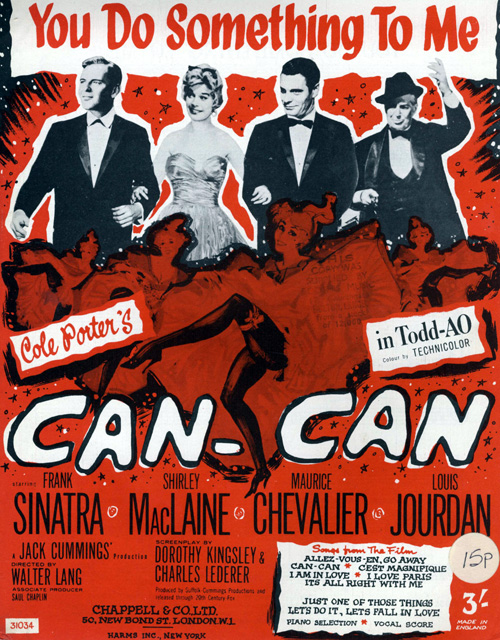
So many people have been enchanted with this tune since the classic version of the Twenties. Here's Leo Reisman's recording; notice how he treats the bridge, with a Charleston-like rhythm. I prefer Lee Wiley, who actually began her career with Leo and sang her version of "You Do" in the 1940s, but you may like Doris Day or the "Emperor of Easy," a young Andy Williams, with his own ring-a-ding flourishes, in the 1950s. Used again and again in films -- Night and Day (Jane Wyman in 1946), The Helen Morgan Story (Gogi Grant in 1957), and Can-Can (Louis Jordan in 1960) -- there's also this touching little scene on television between Judy Garland and Frank Sinatra in the early 1960s -- and a elegantly-orchestrated, beautifully-lit, and bizarrely-sung rendition by Sinead O'Connor on the Arsenio Hall Show from the early '90s. You may also recall Hank Azaria singing it in the 2001 Julia Roberts-Catherine Zeta-Jones movie, "America's Sweethearts." So, pick a decade, and get caught in the spell.

Monday, May 25, 2009

#76: The House I Live In

The house I live in
A plot of earth, a street
The grocer and the butcher
Or the people that I meet
The children in the playground
The faces that I see
All races and religions
That's America to me

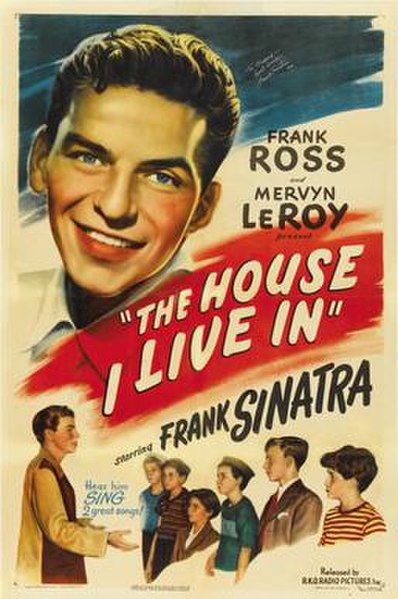
As World War II came to a close in 1945, Frank Sinatra starred in a short film challenging anti-Semitism and racial prejudice. In the 10-minute movie, Frank intervenes upon witnessing a pack of boys bullying one child because of his religion. Frank sets them straight with some tough-talk and then sings the movie's title track, "The House I Live In," a patriotic number by the very liberal Earl Robinson and Lewis Allen. The song's second verse (referring to "my neighbors black and white") was cut from the film, enraging Allen to the point where he had to be removed from the movie theater. The film would go on to win an honorary Academy Award, and the song was covered later by everyone from Paul Robeson to Patti LaBelle.

Saturday, April 25, 2009

#82: I Thought About You

And every stop that we made,
Oh, I thought about you
When I pulled down the shade
Then I really felt blue
I peeked through the crack,
Looked at the track
The one going back to you
And what did I do?
I thought about you

In 1939, composer Jimmy Van Heusen played this soaring melody for Johnny Mercer, who was leaving that evening for Chicago. He rode the Denver Zephyr and mined the trip for inspiration, producing a lyric full of longing. The imagery is classic Mercer, putting us right in the car and cinematically taking us step by step -- from being alone, to spying a sliver in the floor of the car exposing the speeding track, back to "you." Mercer and Van Heusen generally worked with other musicians, but they had a magical moment in "I Thought About You." I'm told that the original artist, Mildred Bailey, performed this memorably, but I can't find a recording on the Web, so Sinatra will be her stand-in.